Choosing an AI development company is difficult because a convincing prototype and a dependable production system can look similar in a demo. The real differences show up later: when the system has to work with company data, call tools, enforce permissions, survive model changes, recover from failures, stay observable, and remain maintainable after the original implementation team steps away.
This guide is designed for buyers evaluating a serious AI build, not for comparing generic agency claims. It focuses on the questions that reveal whether a prospective partner can engineer the full production system around the model.
1. Start with the operating problem, not the model
A credible AI partner should be able to restate the business workflow in operational terms before recommending a stack. That means identifying who uses the system, what information it needs, what decisions it is allowed to make, what actions require approval, what failure looks like, and how success will be measured.
For example, an AI assistant that summarizes documents is fundamentally different from an agent that can update a CRM, issue a refund, modify a schedule, or trigger another system. The second use case introduces permissions, tool contracts, transaction safety, auditability, rollback behavior, and human review. A vendor that treats both as “chatbot development” is collapsing important engineering differences.
At OSYSTIC, these broader production concerns are represented in our AI systems engineering, AI agent development, and enterprise RAG service surfaces.
2. Ask for the architecture boundary map
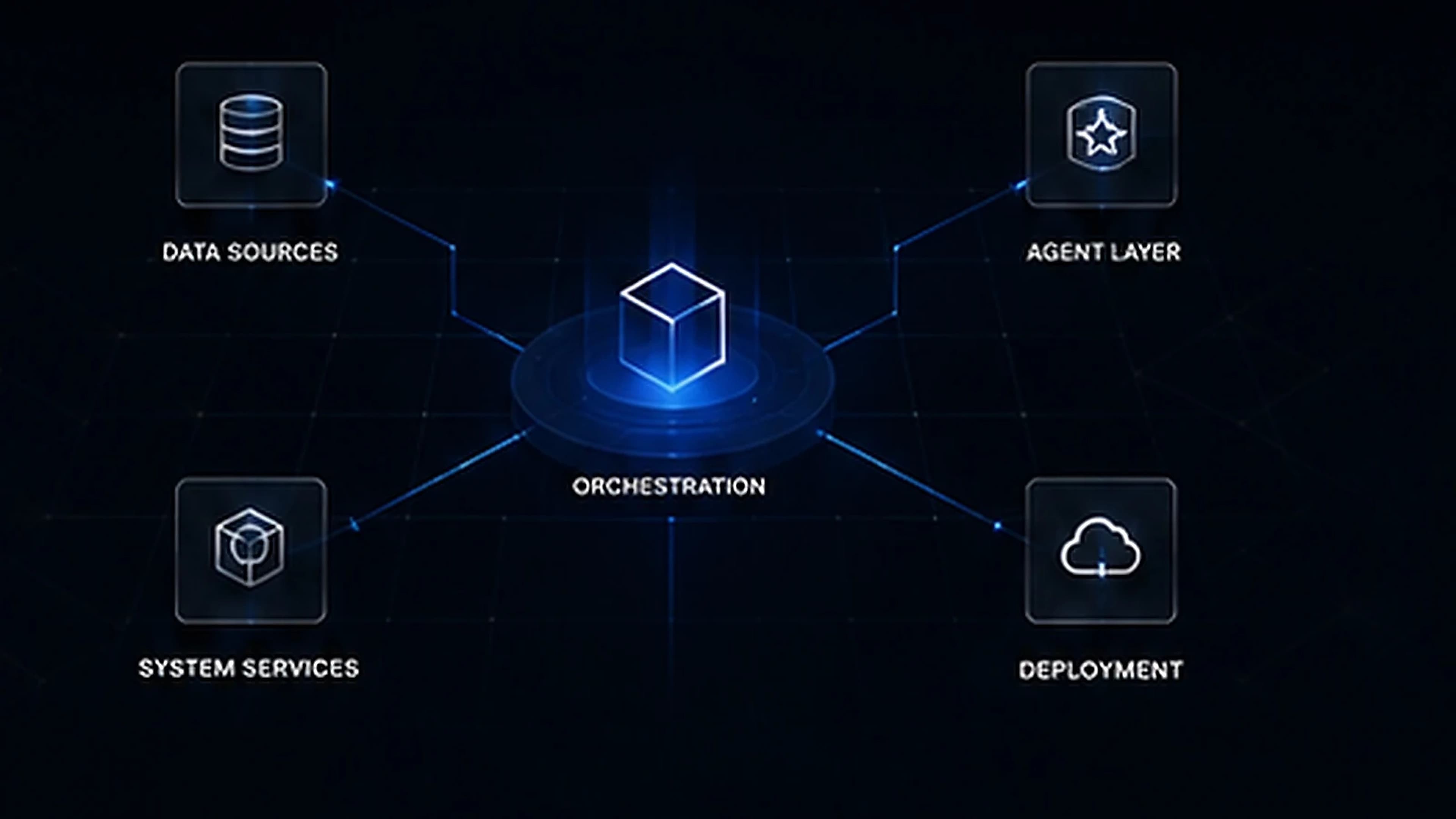
Before implementation, ask the vendor to describe the system as interacting boundaries rather than a list of technologies. A useful architecture discussion should cover:
- the model or model-routing layer;
- retrieval and grounding sources;
- tool and API access;
- identity and permissions;
- application and user-interface boundaries;
- queues, retries, and asynchronous work;
- data persistence and audit records;
- evaluation, tracing, and monitoring;
- deployment environments and release controls.
The exact stack can change. The important question is whether the team understands which boundaries must remain explicit so that a model swap, data-source change, or workflow expansion does not force the entire system to be rebuilt.
3. Treat RAG as a data and permission system, not a vector database
Retrieval-augmented generation can improve grounding, but a production RAG system is more than embeddings plus a vector store. Buyers should ask how ingestion, chunking, metadata, hybrid retrieval, reranking, freshness, source attribution, permission filtering, and evaluation will work together.
Permission-aware retrieval is especially important. If two users have different access rights in the source systems, the AI layer should not flatten those boundaries. The retrieval layer must preserve authorization semantics rather than relying on the model to “remember” who is allowed to see what.
A good vendor should also be able to explain how retrieval quality will be measured. If there is no answer beyond “we will test it manually,” the team may be building a demo rather than an operated knowledge system.
Deep dive: See Enterprise RAG Architecture: Permissions, Hybrid Retrieval, Reranking, Freshness & Evaluation for the production retrieval layer behind this checklist.
4. For agents, inspect tool access and agency limits
AI agents become materially riskier when they can act. OWASP’s 2025 guidance for LLM and generative-AI applications highlights risks including prompt injection, sensitive-information disclosure, improper output handling, and excessive agency. Those risks are not solved by a stronger system prompt. They require application controls.
For any agentic workflow, ask:
- Which tools can the agent call?
- What arguments are validated before execution?
- Which actions require human approval?
- Can the agent create irreversible side effects?
- How are retries made idempotent?
- What happens when a tool partially succeeds?
- How are secrets and credentials isolated?
- Can an untrusted document or webpage influence tool execution?
Strong answers should describe the control plane around the model, not only prompt instructions. Our AI agent and workflow automation page goes deeper into the production patterns we use for tool-using systems.
5. Require an evaluation strategy before production
Generative AI is variable, so traditional deterministic testing is not enough by itself. OpenAI’s current evaluation guidance emphasizes representative datasets, explicit success criteria, automated scoring where useful, human calibration, and continuous evaluation as the system changes.
Before hiring a vendor, ask what the evaluation set will contain. A serious answer should include normal cases, edge cases, known failure modes, adversarial inputs where relevant, and examples taken from the actual operating environment.
Ask how the team will answer questions such as:
- Did the system retrieve the right evidence?
- Did the agent choose the right tool?
- Did it follow the permission boundary?
- Was the answer grounded in the available evidence?
- Did a model or prompt change improve one metric while damaging another?
- Which failures are release blockers?
If quality is judged only by a few hand-picked examples, there is no reliable release gate. See our AI reliability and LLMOps capability for the operational side of evaluation, tracing, and regression control.
Deep dive: Read LLM Evaluation for Production AI: Datasets, Graders, Traces & Release Gates.
6. Ask how the team handles model and vendor change
Model capabilities, prices, limits, and APIs change quickly. The system should not be designed as if one model choice will remain optimal forever.
A resilient architecture separates application behavior from provider-specific implementation where practical. That does not mean abstracting every API behind a complicated framework. It means isolating the places where model selection, routing, structured outputs, embeddings, and provider-specific features enter the system so that change remains manageable.
Ask whether the partner can explain the trade-offs among quality, latency, cost, context limits, tool support, hosting requirements, and data-boundary constraints. A vendor that always recommends the same provider regardless of the use case is not performing architecture selection.
Architecture decision guide: See RAG vs Prompt Engineering vs Fine-Tuning: How to Choose for Production AI.
7. Inspect the MLOps and LLMOps operating model
Google Cloud’s MLOps guidance frames production machine learning as an integrated operating system of source control, testing, deployment, automation, model or artifact management, and monitoring. Generative-AI systems add further concerns such as prompt and model versioning, trace inspection, retrieval evaluation, token cost, and tool-call behavior.
For a production engagement, ask how the vendor manages:
- source control and review;
- environment separation;
- automated tests and evaluation gates;
- deployment and rollback;
- prompt, model, and retrieval changes;
- observability and incident investigation;
- latency and cost monitoring;
- post-launch regression detection.
The answer does not need to involve heavyweight infrastructure for every project. It does need to show that the team understands how the system will be operated after launch.
Operations deep dive: See MLOps vs LLMOps: What Changes for Production Generative AI for the release, monitoring, evaluation, provider-lifecycle, cost, and rollback model.
8. Make security and data boundaries concrete
Do not accept “enterprise-grade security” as an answer. Ask the vendor to map data movement and trust boundaries.
Questions should include:
- What information is sent to a model provider?
- What is stored, cached, or logged?
- How are secrets managed?
- How are user and service identities authenticated?
- How are authorization checks enforced?
- How are retrieved documents filtered by permission?
- How are outputs validated before they reach downstream systems?
- What data must remain in a private or regional environment?
NIST’s Generative AI Profile extends the AI Risk Management Framework with lifecycle-oriented guidance for identifying and managing risks associated with generative AI. The practical buying lesson is simple: risk management belongs in the system design, not in a slide added after the architecture is chosen.
OSYSTIC publishes its general delivery and control posture on the Trust page.
9. Understand deployment and ownership before signing
Many AI projects become difficult at handover because the buyer did not establish who owns the source, environments, prompts, evaluation assets, deployment configuration, data pipelines, and operational knowledge.
Ask for explicit answers to:
- Who owns the application source code?
- Who owns prompts, evaluation datasets, and configuration?
- Which accounts and cloud resources are client-owned?
- What documentation is delivered?
- What access remains after the engagement?
- How are production credentials transferred or rotated?
- What support is required after handover?
A strong partner should be comfortable designing for client ownership from the beginning. Our delivery model describes how scope, acceptance, deployment, documentation, and handover are treated as engineering concerns.
10. Evaluate the team on evidence, not vocabulary
AI terminology is easy to reproduce. Evidence is harder.
Look for proof that the team has built systems with the kinds of constraints your project will face. Useful evidence may include technical case studies, architecture explanations, public engineering work, deployment experience, operational lessons, or detailed discussions of failure modes.
Do not overweight a giant client-logo wall if the vendor cannot explain what they actually built. Conversely, a smaller specialist team can be a strong fit if it can demonstrate precise technical depth, disciplined delivery, and ownership of the full production path.
Review OSYSTIC’s published engineering work in case studies rather than relying on generic capability claims.
11. Red flags during vendor evaluation
| Red flag | Why it matters |
|---|---|
| “We can use AI for anything” | No evidence of use-case qualification or architecture trade-offs. |
| No evaluation plan | Quality will be judged by demos instead of measurable release criteria. |
| RAG described only as embeddings + vector DB | Ignores permissions, freshness, ranking, provenance, and evaluation. |
| Agent safety described only with prompts | Tool access and side effects need application-level controls. |
| No deployment or rollback plan | The team is optimizing for prototype completion rather than operation. |
| No answer on source and infrastructure ownership | Creates avoidable lock-in and handover risk. |
| One model/provider recommended for every project | Suggests tool preference is driving architecture. |
| Security claims without a data-flow explanation | Risk boundaries have probably not been engineered explicitly. |
12. A practical scorecard for shortlisting AI development companies
For a first-pass shortlist, score each vendor from 1 to 5 on the following dimensions:
- Problem framing: Can they translate the use case into workflows, permissions, actions, and measurable outcomes?
- Architecture: Can they explain system boundaries beyond the model?
- Data and RAG: Can they handle ingestion, permissions, retrieval quality, and freshness?
- Agent controls: Can they constrain tool use, approvals, retries, and irreversible actions?
- Evaluation: Do they have a credible pre-release and continuous-evaluation plan?
- Security: Can they map data movement, identities, secrets, and trust boundaries?
- Operations: Do they address observability, deployment, rollback, latency, and cost?
- Evidence: Can they show relevant technical work?
- Ownership: Are source, infrastructure, documentation, and handover explicit?
- Commercial clarity: Are scope, assumptions, acceptance criteria, and change boundaries understandable?
The highest-scoring vendor is not automatically the best fit. The scorecard helps expose where a proposal is strong, where it depends on assumptions, and which risks need to be resolved before commitment.
Final question: can the vendor explain how the system fails?
One of the best signals of engineering maturity is whether a team can describe how the proposed AI system might fail and what the architecture does about it.
Ask that question directly. A mature answer may cover hallucination, retrieval misses, permission leakage, tool failures, malformed outputs, prompt injection, provider outages, latency spikes, model regressions, partial transactions, stale data, and human escalation.
A team that can reason concretely about failure is usually better prepared to build for reliability.
If you are evaluating an AI initiative and want to discuss the architecture before committing to a stack, you can send OSYSTIC a technical brief or review our AI development capabilities.
Related architecture guide: For the control-plane design behind tool-using agents, see AI Agent Architecture: Tools, State, Permissions, Retries & Human Review.