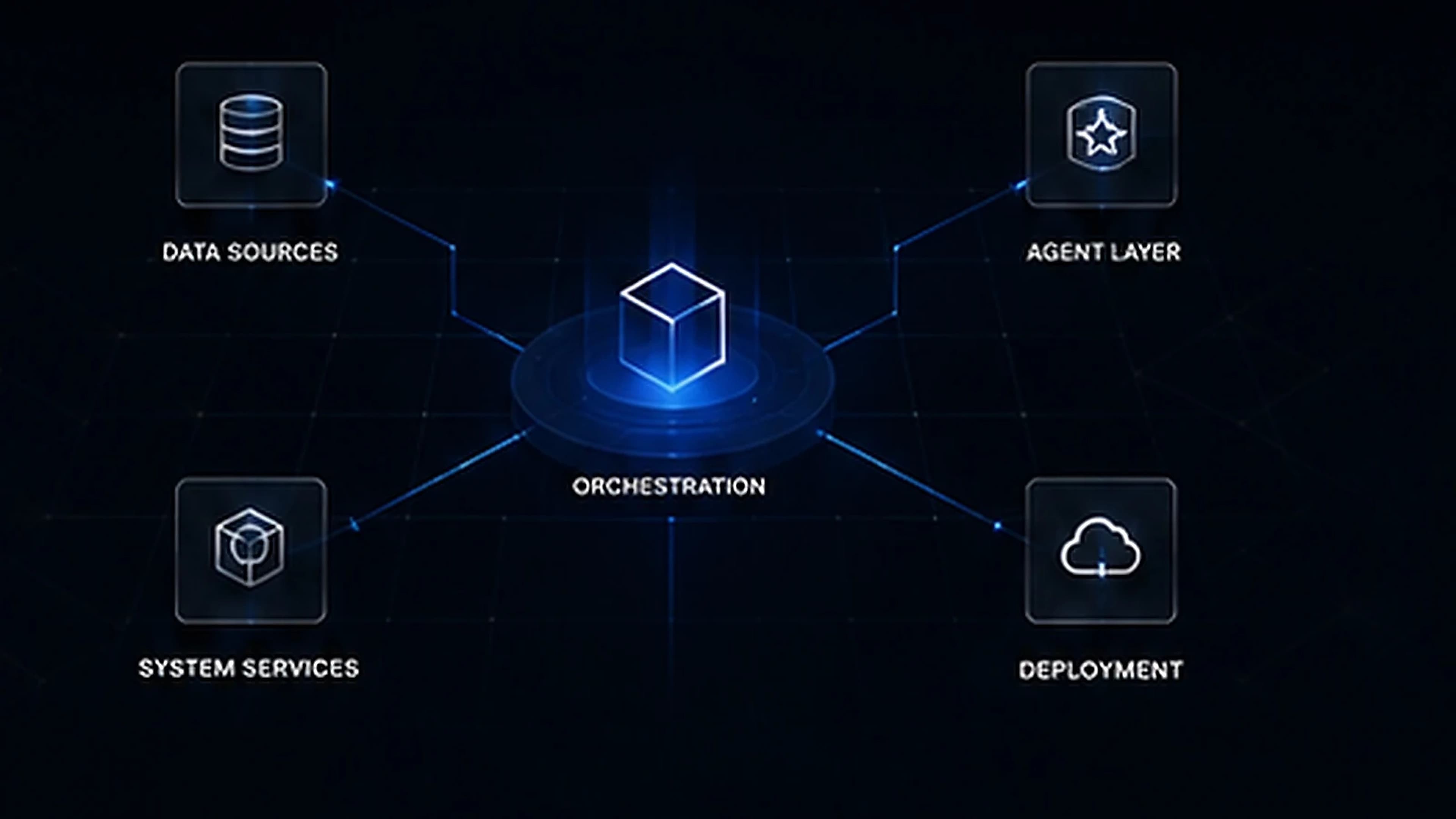
LLMOps does not replace MLOps. It extends the operational surface.
Traditional MLOps established the disciplines needed to move machine-learning systems from experimentation into reliable production: versioned code and data, repeatable training, model registries, automated testing, deployment pipelines, monitoring, rollback, governance, and feedback loops. Those foundations remain useful for generative AI.
What changes is the number of moving parts that can alter system behavior without a conventional retraining cycle. A production LLM application may change because a prompt changed, a model snapshot changed, a retrieval index was rebuilt, a reranker was upgraded, a tool schema changed, an agent handoff was modified, a guardrail was added, or a provider deprecated an API surface. LLMOps is the operating model for managing those additional sources of change.
For the evaluation layer behind these release decisions, see LLM Evaluation for Production AI. For agent-specific operations, see AI Agent Architecture. For retrieval lifecycle concerns, see Enterprise RAG Architecture.
1. What MLOps already gets right
Generative AI teams should not discard the engineering practices learned from production machine learning.
Core MLOps principles still matter:
- source control and peer review;
- environment separation;
- reproducible builds;
- versioned datasets and artifacts;
- automated tests;
- deployment pipelines;
- rollback capability;
- monitoring and alerting;
- data governance and access control;
- feedback from production into future improvements.
Microsoft's LLMOps guidance explicitly frames generative-AI operations as an end-to-end lifecycle that still includes data curation, experimentation, evaluation, validation, deployment, inference, monitoring, and feedback. Google similarly describes LLMOps as a specialization of MLOps rather than a completely separate discipline.
2. The unit of change becomes the application, not only the model
In a conventional predictive ML system, a major behavior change often comes from a new model artifact, feature pipeline, or training dataset. In an LLM application, behavior can change while the base model stays exactly the same.
Examples include:
- a system instruction changes;
- few-shot examples change;
- a retrieval corpus or chunking strategy changes;
- embedding or reranking configuration changes;
- tool descriptions or JSON schemas change;
- an agent gains or loses a tool;
- a routing rule sends traffic to another model;
- a safety policy or approval boundary changes.
That means the deployable artifact is better thought of as the AI application configuration: model + prompts + retrieval + tools + policies + workflow + evaluation baseline.
3. Prompts become versioned application logic
Prompts should not live as anonymous text copied between dashboards and code.
OpenAI's current prompting guidance recommends treating prompts as application code: store them in named modules, review changes in pull requests, test them with representative fixtures and evaluations, and use ordinary software-release mechanisms such as Git history, release tags, and feature flags.
A practical prompt release record should identify:
- prompt or instruction version;
- model and snapshot;
- tool definitions available to the prompt;
- retrieval configuration;
- evaluation dataset version;
- grader configuration;
- release date and rollback target.
This lets a team answer a critical production question: which exact application configuration produced this output?
4. Model-provider lifecycle becomes an operational dependency
Hosted foundation models are external dependencies with their own release and deprecation schedules. A provider can introduce a new model, retire an older snapshot, change a product surface, or migrate an API.
OpenAI currently recommends pinning production applications to specific model snapshots where consistency matters and running test/evaluation suites when changing versions. Its current platform is also deprecating several prompt/evaluation surfaces in late 2026, which illustrates why provider lifecycle must be tracked as an operations concern rather than a surprise migration project.
LLMOps should therefore maintain:
- approved model/provider inventory;
- pinned production versions where available;
- deprecation and end-of-support dates;
- replacement evaluation results;
- fallback or rollback models;
- migration owners and deadlines.
5. RAG adds a second data lifecycle
Traditional MLOps already manages training and validation data. RAG adds a live retrieval corpus whose quality can change independently of the model.
Production RAG operations need to version or observe:
- source connectors;
- document permissions;
- chunking logic;
- embedding model and dimensions;
- metadata schema;
- keyword/vector weighting;
- filters;
- reranking model and settings;
- index build time and freshness;
- deletion and ACL synchronization.
A model rollback does not fix a bad index rebuild. LLMOps therefore needs retrieval-specific health checks and evaluation gates alongside model/prompt tests.
See Enterprise RAG for the implementation surface.
6. Agent systems add tool and workflow releases
Agents introduce an execution layer. Changes to a tool schema, permission policy, handoff rule, retry policy, approval gate, or stopping condition can be as significant as changing the model itself.
An agent release should therefore track:
- available tools and versions;
- validated input schemas;
- service identities and permission scopes;
- approval requirements;
- retry and idempotency behavior;
- maximum iterations/tool calls;
- handoff or routing rules;
- trace and audit settings.
A safe deployment pipeline should run trace-level evaluations that verify not only the final answer but also which tools were called, whether approval occurred, whether the run stayed within limits, and whether side effects were handled correctly.
7. Evals become part of CI/CD
Traditional software tests remain necessary but are not sufficient for nondeterministic AI behavior.
OpenAI's current evaluation guidance recommends continuous evaluation because model outputs can vary and system behavior can change across models, prompts, tools, and architectures. A production LLM release pipeline should run representative evaluations on every meaningful change.
Typical release gates include:
- task accuracy or rubric score not below baseline;
- no regression on known high-risk cases;
- RAG retrieval metrics within threshold;
- groundedness and citation requirements met;
- tool-selection and argument accuracy within threshold;
- no critical authorization or safety failures;
- latency and cost within agreed budgets.
The evaluation system should be portable. Vendor evaluation products can change; the durable assets are your datasets, expected behavior, graders, traces, and release criteria.
8. Observability shifts from infrastructure to decision traces
CPU, memory, request rate, error rate, and database health still matter. But they do not explain why an LLM application made a bad decision.
LLMOps observability should add:
- model and snapshot;
- prompt/instruction version;
- retrieved evidence and ranking;
- tool calls and results;
- agent handoffs;
- guardrail or policy outcomes;
- approval events;
- token usage;
- model/tool latency;
- estimated cost;
- final outcome and user feedback.
OpenAI's current tracing guidance records model calls, tool calls, errors, durations, and outcomes for agent workflows. Whatever platform you use, you need comparable visibility to diagnose production failures.
9. Cost becomes a first-class reliability metric
For many LLM applications, cost is coupled directly to behavior.
A prompt change can increase input tokens. A RAG change can increase context size. A routing change can send more traffic to an expensive model. An agent loop can multiply calls. A retry bug can duplicate tool execution.
Monitor cost at the same granularity as reliability:
- cost per request or task;
- input/output tokens;
- retrieval/reranking cost;
- tool/API cost;
- agent steps per run;
- retry overhead;
- cost by tenant, feature, model, and workflow.
Release criteria should prevent a quality improvement from silently creating an unacceptable cost regression.
10. Latency budgets need stage-level ownership
End-to-end latency is composed of multiple stages: retrieval, reranking, model generation, tool calls, subagents, approvals, and retries.
LLMOps should measure each stage separately. This lets teams optimize the actual bottleneck rather than guessing.
Useful controls include:
- prompt/context size;
- model routing;
- candidate retrieval count;
- reranking depth;
- parallel versus sequential tool calls;
- cache strategy;
- agent loop limits;
- timeouts and escalation paths.
11. Security moves into the runtime workflow
Security for generative AI is not only model access control.
Production controls must cover:
- prompt injection and untrusted retrieved content;
- cross-tenant data access;
- tool authorization;
- secret isolation;
- sensitive-data handling;
- human approval for consequential actions;
- auditability of autonomous actions;
- provider/data-boundary requirements.
These controls should be testable. A security requirement that exists only in a system prompt is not an enforcement boundary.
12. Feedback loops become evaluation data pipelines
Production feedback should feed more than a dashboard.
Useful signals include:
- thumbs-up/down or explicit ratings;
- user corrections;
- operator overrides;
- failed or abandoned agent runs;
- retrieval misses;
- support tickets;
- high-cost or high-latency outliers;
- safety escalations.
Turn meaningful failures into labeled regression cases. This converts production incidents into permanent tests and makes future releases safer.
13. MLOps vs LLMOps operating comparison
| Operational area | MLOps emphasis | LLMOps / GenAIOps extension |
|---|---|---|
| Versioning | Code, data, features, model artifacts | Prompts, model snapshots, retrieval config, tool schemas, workflows, policies, graders |
| Testing | Unit/integration tests, offline model metrics | Representative evals, model judges, trace grading, safety/authorization tests |
| Data | Training/validation datasets | RAG corpus, ACL metadata, feedback/eval datasets, production traces |
| Deployment | Model + application release | Model + prompt + RAG + tools + agent workflow as one release configuration |
| Monitoring | Drift, prediction quality, infra health | Groundedness, retrieval, tool paths, traces, tokens, cost, latency, safety |
| Rollback | Model/application artifact | Any combination of model, prompt, retrieval, tool, workflow, policy configuration |
| External dependencies | Libraries, infrastructure, data sources | Foundation-model providers, snapshots, hosted tool/search/eval APIs and deprecations |
14. A practical LLMOps release bundle
Before deploying a generative-AI change, capture a release manifest containing:
- application commit;
- model/provider/snapshot;
- prompt/instruction version;
- retrieval/index version and configuration;
- tool definitions and agent workflow version;
- policy/guardrail configuration;
- evaluation dataset and grader versions;
- quality, latency, cost, and safety results;
- rollback configuration;
- deployment owner and approval record where needed.
This is the operational equivalent of a reproducible model release in MLOps.
15. LLMOps anti-patterns
| Anti-pattern | Why it fails |
|---|---|
| Prompts edited directly in production | Behavior changes without review, tests, or rollback history. |
| "Latest" model alias with no eval gate | Provider changes can alter behavior unexpectedly. |
| RAG index rebuilt with no retrieval regression test | Search quality can regress while model quality is unchanged. |
| Only infrastructure monitoring | The system can be healthy while producing poor or unsafe decisions. |
| No tool/agent trace retention | Autonomous failures are difficult to investigate. |
| Cost reviewed only on the monthly bill | Runaway prompts, loops, or model routing are detected too late. |
| Evaluation tied to one vendor product | Provider migrations can erase the quality-control workflow. |
| No provider deprecation register | Critical migrations become emergency work. |
16. What a mature operating loop looks like
- Develop prompts, retrieval, tools, and workflows in version control.
- Run deterministic tests and representative AI evaluations.
- Compare quality, latency, cost, and safety against the current baseline.
- Review and deploy the complete application configuration.
- Trace production behavior and monitor operational budgets.
- Capture user/operator feedback and production failures.
- Add meaningful failures to regression datasets.
- Iterate with a reproducible release and rollback path.
That loop is LLMOps in practical terms: MLOps discipline expanded to the full generative-AI application.
Sources and further reading
- Microsoft — LLMOps: Operational management of LLMs
- Google Cloud — What is LLMOps?
- OpenAI — Prompting
- OpenAI — Text generation and model snapshot guidance
- OpenAI — Evaluation best practices
For implementation, review OSYSTIC AI Reliability & LLMOps, AI Systems Engineering, or send a technical brief.